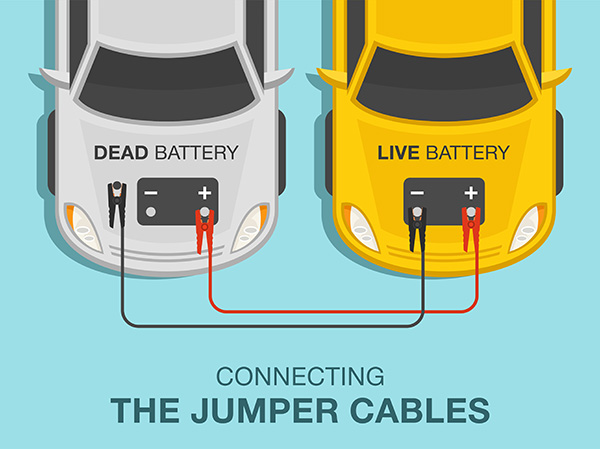
There is a very specific type of silence that happens when you turn your key and absolutely nothing occurs. It usually happens when you are already five minutes late for work or standing in a grocery store parking lot with a trunk full of melting ice cream. A dead battery is one of those universal car troubles that feels like a huge disaster in the moment, but it is actually something you can handle with a little bit of knowledge and a set of jumper cables.
At our shop, we believe that every driver should know how to safely wake up a sleeping engine. While we are always happy to see you for a battery test or a replacement, we also want you to be able to get yourself out of a jam. Jumping a car is a simple process, but it does require you to follow a very specific order to keep both the cars and the people safe.
Getting Ready for the Spark
Before you start connecting cables, you need to find a helpful person with a running car. Once you have a donor vehicle, position it so that the two cars are close together. Usually, nose to nose is the best way to make sure the cables can reach both batteries without being pulled tight. Make sure the cars are not touching each other, as this can create an electrical path that you do not want.
Turn off both engines and set the parking brakes. It is also a good idea to turn off any headlights, heaters, or radios in both cars so that all the power goes straight to the battery. Open both hoods and locate the batteries. You are looking for the positive terminal, which is usually marked with a plus sign and a red cover, and the negative terminal, which has a minus sign and is often black.
The Order of the Clamps
The most important part of jumping a car is the sequence of the connections. If you do this out of order, you might see some scary sparks or damage the expensive computers that run modern vehicles. Think of it as a circuit that you are carefully building piece by piece.
- Connect the first red clamp to the positive terminal of the dead battery.
- Connect the other red clamp to the positive terminal of the healthy battery.
- Connect the first black clamp to the negative terminal of the healthy battery.
- Connect the final black clamp to a clean, unpainted metal part of the engine block on the car with the dead battery.
That last step is where people often get confused. You do not want to put the last black clamp on the dead battery itself. Attaching it to a metal bolt or a bracket on the engine provides a safe ground and keeps any potential sparks away from the battery gases.
Starting the Engines
Once all four clamps are secure, start the engine of the donor car. Let it run for about five minutes. This allows the healthy alternator to send a steady stream of energy into the dead battery. If your battery is completely drained, it might need a little more time to build up enough strength to turn the starter.
After a few minutes, try to start your car. If it starts up, do not turn it off immediately. If it does not start, give it another five minutes and try again. Once your car is running, you can remove the cables in the exact opposite order that you put them on. Start with the black ground clamp on your car, then the black clamp on the donor car, then the red clamp on the donor car, and finally the red clamp on your own car.
Why Did the Battery Die
A jump start is a great way to get moving, but it is rarely a permanent solution. Batteries are like big chemical storage tanks, and they eventually lose their ability to hold a charge. Most batteries last between three and five years. If yours is older than that, a jump start might just be a temporary bandage on a bigger problem.
You should also keep an eye out for corrosion. That white, crusty powder on the terminals can block the flow of electricity. If your battery keeps dying even after a long drive, your alternator might not be doing its job of recharging the battery while the engine runs.
Let MB Clinic Take a Look
While you can certainly jump your own car, you should not have to do it every morning. If you find yourself needing a boost more than once, it is time for a professional opinion. Bring your vehicle by MB Clinic in Denver, CO, so we can run a full electrical system test.
We carry top quality battery replacements and can get you back on the road with a battery you can actually trust.